The Benefits of Hormone Therapy: What the Science Really Shows
Let's talk about the often-ignored side of Menopause Hormone Therapy (MHT): its benefits! For too long, the conversation has been dominated by fear and misinformation. It's time to set the record straight with what the science actually tells us.
The Women's Health Initiative: What Really Happened
Before we dive into the benefits, we need to address the Women's Health Initiative (WHI)—the study that changed everything about how we talk about hormone therapy.
Many people call this a "flawed" or "bad" study. I disagree. This study actually showed us how safe and beneficial hormone therapy has always been. The problem wasn't the study itself (although it did have its flaws, especially the age range of the participants and the fact that they were asymptomatic!—it was how the risks were mischaracterized and leaked to the media before the full results were released. That led to hormone therapy use plummeting overnight in 2002.
The Real Story
Before the WHI, more and more women were taking HRT. They had oral conjugated equine estrogen (Premarin) and oral progestins, and doctors and patients were noticing that women not only felt better symptom-wise, but also seemed to be staying healthier overall. In fact, there were some observational studies that suggested lower health risks for women using HRT compared to non-users.
Word got out, and more postmenopausal women started HRT. That's when the FDA stepped in and said, "Wait, we need actual proof that HRT prevents diseases before we allow widespread prescribing for this reason." So the WHI was born as a prevention trial. The Primary goal of the study was to determine if HRT prevented cardiovascular events (heart attacks, strokes, etc.)
They recruited 27,000 women aged 50-79, with an average age of 63. Women with a uterus received oral estrogen (CEE) plus progestogen (Medroxyprogesterone Acetate), and those without a uterus received estrogen alone.
What They Actually Found
After 5 years, they found a tiny, non-statistically significant increase in breast cancer risk in women over age 60 who were on estrogen plus progestogen. We're talking about eight additional women per 10,000—an absolutely tiny risk.
Over 20 years of follow-up, they found no increased risk of death from breast cancer. Women were no more likely to die from breast cancer on hormone therapy than on placebo.
And the kicker? Women on conjugate equine estrogen alone had a 22% reduced risk of breast cancer. Somehow, this never made the New York Times….
What We Know Now: The Real Benefits of MHT
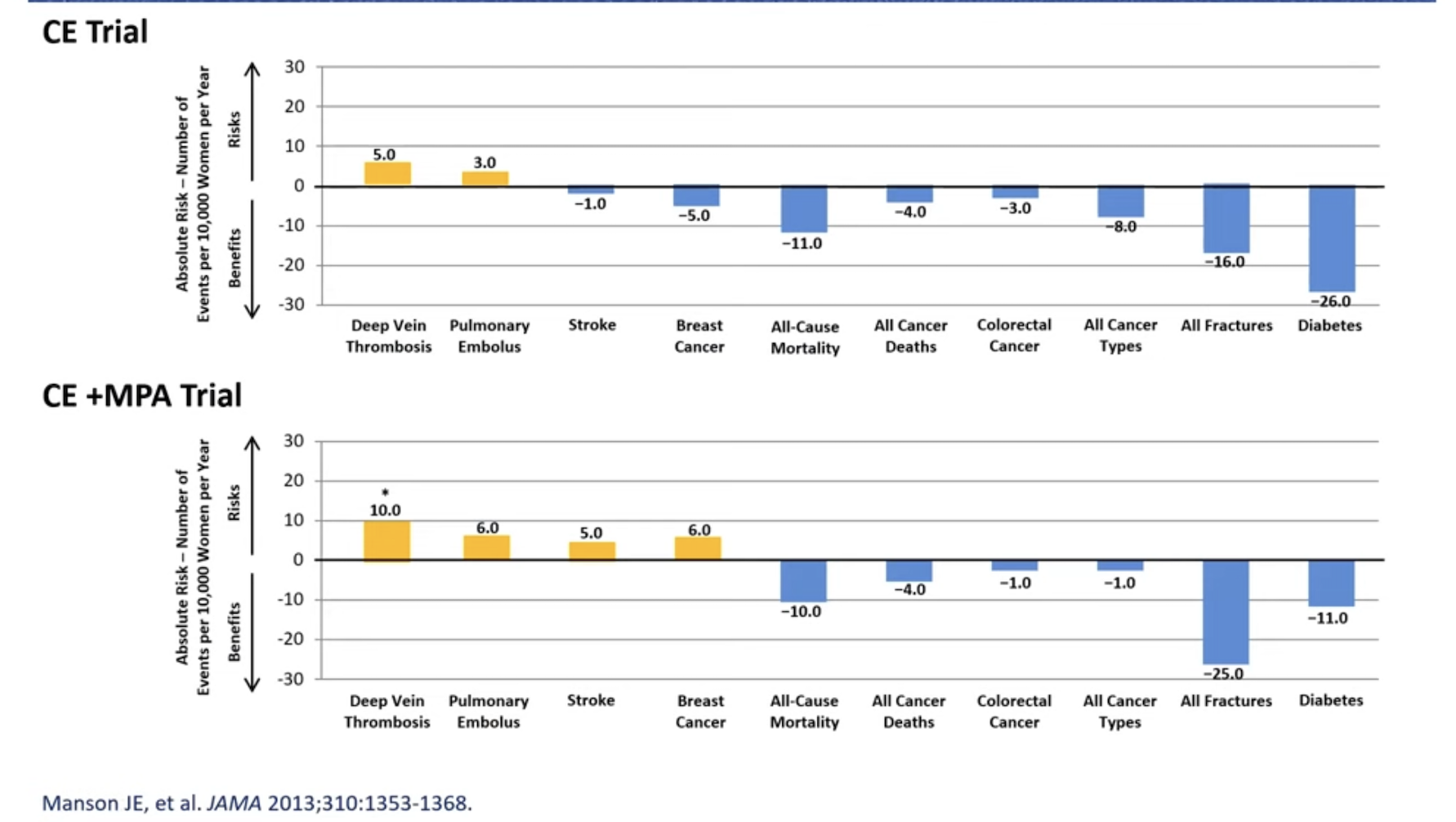
Fortunately, much more data has become available in the last two decades. Here's what we now know about the benefits of MHT for women who initiate MHT between the ages of 50-59 (I have attached the data in graph form at the end of this post):
Bone Health: A Game-Changer
MHT reduces the risk of osteoporosis-related fractures by:
50% for women in their 50s
25% for women in their 60s
This is huge! Estrogen doesn't just improve bone density—it also improves bone resilience. It makes our bones both strong and flexible, which makes fractures less likely.
Diabetes Prevention: The Overlooked Benefit
Here's a little-known fact: MHT reduces the risk of diabetes for women in their 50s and 60s. While everyone was freaking out about breast cancer risks, this incredible benefit was completely overlooked.
Heart Health: The Big One
MHT reduces the risk of heart-related death and heart attack by almost 50% for women in their 50s.
Interestingly, the WHI showed no change in risk for women aged 60-69. However, newer studies have shown that body-identical MHT does reduce the risk of cardiovascular death and heart attack even in women over 60! My take on this is that women who are symptomatic (vasomotor symptoms) are are higher risk of developing CVD, and remember the women in the WHI were ASYMPTOMATIC. In case you’re wondering why, it is because hormone therapy was so effective at resolving vasomotor symptoms, the women would know right away if they were on a placebo or the real thing…and this would compromise the reliability of the study.
Brain Health and Dementia
The WHI showed an increased risk of dementia for women who started MHT more than 10 years after menopause. But newer data from the U.K. demonstrates that within 10 years of menopause, estrogen alone or combined with progesterone may reduce the risk of dementia. I want to be clear here- the data with respect to dementia risk remains mixed, however the key point is that the risk was likely overstated, and the data is quite clear that chronic sleep deprivation and inactivity do increase the risk of cognitive decline. If VMS are preventing women from sleeping, then MHT may have an indirect but meaningful impact on their risk of dementia.
We are not yet at the point where we can prescribe MHT for dementia prevention, however it is crucial to address whatever symptoms are impairing your sleep, exercise capacity, and quality of life in order to maintain your beautiful brain as you age.
All-Cause Mortality: Living Longer
MHT appears to reduce all-cause mortality (death from any cause) in women in their 50s, regardless of the type used.
For women over 60 when they start, there's no difference with synthetic MHT, but there is a reduction in all-cause mortality for women using body-identical MHT.
Think about that: hormone therapy may help you live longer.
Quality of Life Benefits
Beyond these major health outcomes, MHT is incredibly effective at:
Reducing hot flashes and night sweats by up to 90%
Dramatically improving sleep quality
Improving mood and reducing irritability
Helping with brain fog
Reducing joint and muscle pain
Improving skin and hair health
Who Benefits Most?
The research is clear: MHT offers the most benefits when started within 10 years of menopause, particularly for women in their 50s.
Technically, Canadian guidelines say doctors should only prescribe MHT to postmenopausal women who have:
Moderate to severe hot flashes
Premature menopause
Elevated risk for osteoporosis or fracture
But every expert in this field knows that MHT is very helpful for mood symptoms, sleep disturbances (particularly when night sweats are the culprit), and all the downstream benefits from those improvements. The medical community is becoming increasingly open to prescribing it for these reasons.
There's exciting research happening in Canada right now to prove the efficacy and safety of MHT for mood as the primary treatment target. Stay tuned!
The Bottom Line
While the whole world was focused on the supposed risks of breast cancer, the enormous benefits of MHT were overlooked entirely. Benefits like:
✓ Dramatically reduced fracture risk
✓ Lower diabetes risk
✓ Heart disease prevention for women under 60
✓ Reduced death from all causes
✓ Better quality of life across the board
Menopause Hormone Therapy is the first-line treatment for symptoms of menopause, and it's the only treatment with known benefits for bone health, heart health, diabetes prevention, and all-cause mortality.
The conversation around MHT is changing. Armed with current data and better understanding, more women can make informed decisions about whether hormone therapy is right for them.
Don't let outdated information from 2002 dictate your healthcare in 2026. Have an informed conversation with a healthcare provider who understands current MHT research.
Important Disclaimer: This blog post is for educational and informational purposes only and is not intended as individual medical advice. The decision to use Menopause Hormone Therapy should be made in consultation with a qualified healthcare provider who can assess your individual health history, risk factors, family history, and specific needs. The benefits described here represent population-level data and may not apply to every individual. Some women may have contraindications to MHT. Always discuss your personal situation, symptoms, and treatment options with your doctor to determine what's appropriate for you.
GRAPH: Absolute risks and benefits (per 10,000 women) from the Women’s Health Initiative for women who initiate hormone therapy (Conjugate Equine Estrogen (CE) or Conjugate Equine Estrogen + Medroxyprogesterone Acetate (MPA)) between the ages of 50 and 59.